
Commercial Carpet Cleaning for Mobile Offices: A Practical Guide
Last Updated: November 10, 2026
Quick Summary
Mobile office carpet cleaning requires controlling moisture because these carpets sit over lightweight floor systems rather than concrete. Low-moisture cleaning, encapsulation, or a limited hot-water pass with verified drying are the usual options, chosen by floor type, soil level and the reoccupation window. Ask providers to state expected drying time in writing.
- Mobile office carpets sit on lightweight floor systems, so too much water can soak the subfloor and loosen seams.
- Low-moisture cleaning usually dries within a few hours, which suits a same-day turnaround.
- Encapsulation puts very little water into the backing and suits thin modular floors.
- Hot-water extraction removes the most embedded soil but needs moisture readings before and after.
- A full deep clean is recommended every 6-12 months, with interim maintenance between cleanings.
Table of Contents
- Why Mobile Office Carpets Need a Different Cleaning Approach
- Commercial Carpet Cleaning Cost for a Mobile Office
- Choosing a Cleaning Method for Modular Floors
- Office Carpet Cleaning Schedule and Interim Maintenance
- Finding Commercial Carpet Cleaning Services for Mobile Offices Near You
- Frequently Asked Questions
Why Mobile Office Carpets Need a Different Cleaning Approach
A mobile office carpet is usually installed over a lightweight floor system, not a concrete slab, so mobile office carpet cleaning has to account for that difference. That changes how much water is safe to use and how long the floor takes to dry. Too much moisture can soak the subfloor, loosen seams and invite odor or mildew, so the method matters as much as the cleaner.
Foot traffic is also concentrated. Entry paths, the area in front of desks, and the space near doors wear out first. A good plan treats those zones more often than the rest of the room.
Site Constraints That Shape the Job
Most mobile offices have a few limits that affect the job:
- Limited power. Portable units may share a single circuit, so equipment needs to be sized correctly.
- Tight access. Steps, ramps and narrow doorways limit how large a machine can be.
- Short downtime. Staff may need the space back the same day, so drying time is critical.
- Temporary placement. Some units will move, so the cleaning plan should match the expected lease length.
Knowing these constraints before the crew arrives helps avoid rework and surprise delays.
Commercial Carpet Cleaning Cost for a Mobile Office
Pricing for mobile office carpet cleaning depends on the scope of the job and the conditions at the site. For a quote specific to your site, contact FreshStart Cleaning Service directly.
When comparing quotes, it helps to ask each provider for the same scope so the totals can be read side by side. Read the scope carefully before comparing totals, since a quote that is far below the others may leave out pre-treatment, moving furniture or a final moisture check.
Mobile-office sites can affect the job in several ways. Limited access, power constraints, water access, parking, site rules and any requirement to work outside business hours may all add time to the work.
When you request a written quote, it is reasonable to ask the provider to itemize the scope, including the square footage used, the cleaning method, expected drying time and any additional charges, so you can see what is included.
For a recurring plan, ask whether a contracted schedule changes the rate. Tracking the cost and how long the carpet stays presentable between visits over two or three service cycles can help you judge whether the arrangement is working. If that number climbs while the appearance declines, the method or schedule needs review.
For a quote specific to your site, contact FreshStart Cleaning Service for current pricing.
Choosing a Cleaning Method for Modular Floors
Most mobile offices sit on a lightweight floor system, often a raised platform or a modular subfloor with a thin underlayment. That makes the cleaning method a question of moisture control as much as soil removal. Three approaches cover most jobs, and each one trades soil removal against drying time and equipment access.
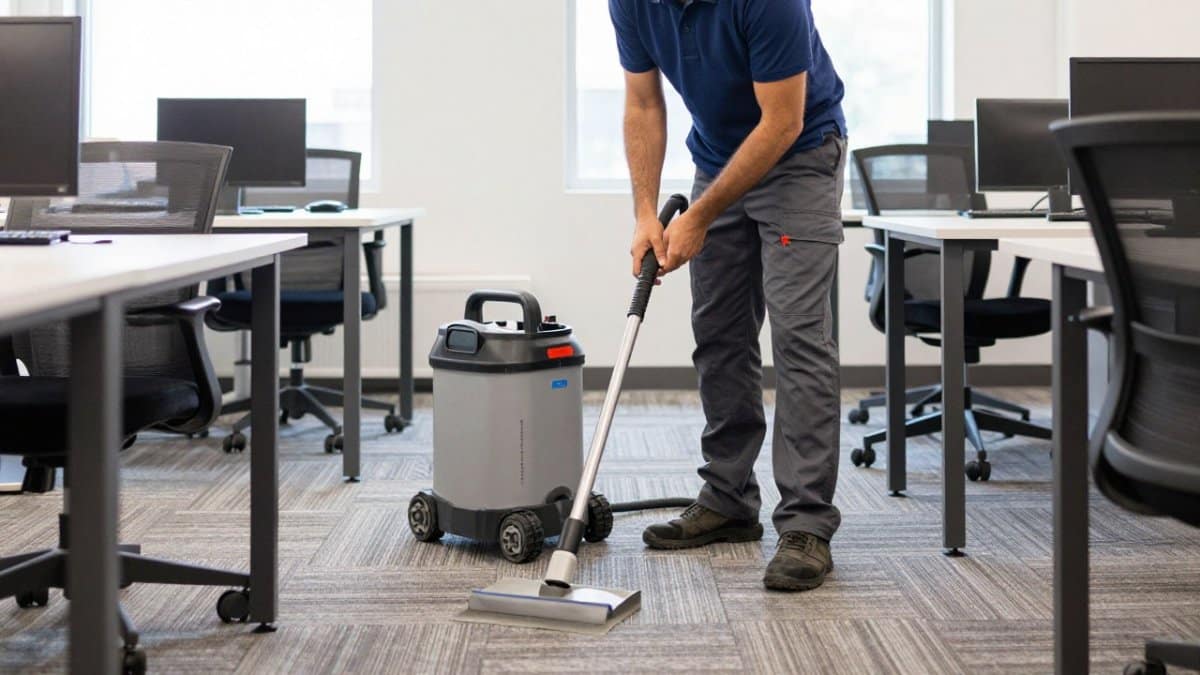
Hot-water extraction, often called steam cleaning, is a common method that injects heated water and cleaning solution into the fiber and pulls it back out with suction. For a closer look at the advanced techniques and equipment used for carpet cleaning in Alabama, see that guide. It removes the most embedded soil and is the right choice when carpet is heavily soiled or when a previous service left residue. The trade-off is water volume. On a modular floor, the subfloor can take longer to dry than the carpet surface suggests, so this method calls for a shorter pass, a stronger vacuum stage, and fans or dehumidification running until readings return to normal.
Low-moisture cleaning uses a small amount of solution agitated into the pile, followed by dry extraction. It leaves little standing water and usually dries within a few hours, which suits a single-day turnaround in a space that staff need back the same afternoon. It handles routine soil well but may not lift deep-set grit or older stains.
Encapsulation uses polymer-based cleaners that crystallize dry soil so it can be vacuumed away. Very little water reaches the backing, so it is often the safest option for thin modular floors where moisture is the main risk. Its limit is that it works best on carpet that is cleaned regularly. Long-neglected carpet usually needs an extraction pass first.
A workable way to decide is to check three things before the crew starts. First, look at the floor system: if the subfloor is particleboard or the units are relocatable with minimal underlayment, lean toward low-moisture or encapsulation. Second, look at the soil: heavy, long-term soiling in traffic lanes may justify a targeted hot-water pass on those zones only. Third, look at the schedule: if the space must reopen within hours, the method has to fit that window, and the provider should state the expected drying time in writing.
Watch out: a deep, wet pass over a modular floor without a moisture reading before and after can leave the subfloor damp for a day or more, which invites odor, staining at seams and warping at joints.
Ask any provider which method they propose, why it fits your floor system, and when the space can be reoccupied. A provider who cannot answer those four questions clearly is not yet ready to work on a mobile office.
Office Carpet Cleaning Schedule and Interim Maintenance
Many offices do best with a two-tier schedule. A full deep clean is done every six to twelve months, depending on traffic and the number of occupants. Between deep cleans, interim maintenance keeps the carpet looking good and slows soil buildup. Learn which everyday hazards wear carpet down and how often it needs attention.
| Task | Typical Frequency | Purpose |
|---|---|---|
| Vacuuming high-traffic paths | Daily or several times a week | Removes grit before it grinds into fiber |
| Spot treatment of spills | Same day | Prevents permanent staining |
| Interim cleaning | Monthly or quarterly | Maintains appearance between deep cleans |
| Full deep cleaning | Every 6-12 months | Restores carpet and removes built-up soil |
Scheduling interim cleaning after hours avoids disrupting staff and lets the carpet dry overnight.
Finding Commercial Carpet Cleaning Services for Mobile Offices Near You
When searching for a provider, look for experience with modular and temporary office spaces, not just residential work. You can book professional carpet cleaning in Mobile, AL and schedule a free inspection. Ask whether the company is insured and licensed for commercial work, whether it can clean after hours, and how it handles drying time.
FreshStart Cleaning Service is a locally owned, fully licensed and insured business serving Alabama, including Mobile and Baldwin County. You can review the full range of carpet cleaning services in Mobile and request a free estimate. The company is owned and operated by a 25-year military veteran and uses eco-friendly, non-toxic cleaning agents that are safe for pets and children.
Frequently Asked Questions
How much do commercial carpet cleaning services cost for a mobile office?
Pricing depends on the square footage, the number of rooms, how soiled the carpet is, and whether cleaning happens during or after business hours. Ask for a written estimate that lists the scope and any add-ons such as stain treatment or deodorizing. For current rates, contact FreshStart Cleaning Service directly.
How often should carpets in a mobile office be professionally cleaned?
Most mobile offices with steady foot traffic benefit from a professional deep clean every few months, supplemented by interim maintenance between visits. Higher-traffic entryways, offices with pets or food, and sites with dust from nearby construction may need more frequent service. A regular schedule keeps soil from grinding into the fibers and extends the carpet’s useful life.
Can commercial carpet cleaners work around office hours?
Yes, many commercial carpet cleaners offer after-hours or early-morning service so staff are not disrupted. Mobile offices often have limited access points and tight parking, so confirm the arrival window, power access, and where equipment will be staged before the appointment. FreshStart Cleaning Service is fully insured and can be contacted to discuss your operating hours.
How long does commercial carpet cleaning take to dry?
Drying time depends on the cleaning method, airflow, humidity, and how thoroughly moisture is extracted. Low-moisture methods typically allow faster return to use than heavy hot-water extraction. Ask the provider how long the area will be unusable and whether they use air movers to speed drying, so staff can plan around the downtime.
